Archipelagos of Sanity
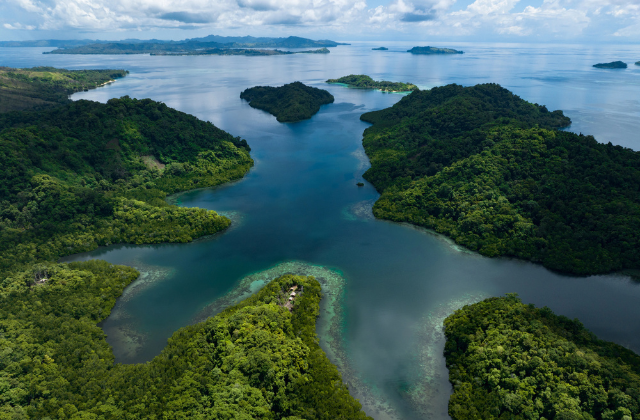
“What really counts in each of us and in our lives are the bonds of love – which can make one’s life not an episode but part of a larger continuum”.
Aurelio Peccei, founder of the club of Rome [1]
I’ve been talking about this for a while. It came to me in a flash back in Spring last year during a meeting of the Sustainability Coaching Coalition. Referencing Margaret Wheatley’s well known concept, a colleague declared we needed to create more Islands of Sanity. What we need to create, I found myself responding, is not islands but archipelagos of sanity! To my surprise the idea has caught on – people are excited, intrigued…
Why archipelagos rather than islands? What is it about archipelagos that appeals? And why sanity – rather than creativity or rest or pleasure?
The idea has been ebbing and flowing over this last year, the writing pushed often to one side by the urgent, but constantly nibbling at the edges of my consciousness nonetheless. So here are my attempts to unravel the idea a little and make sense for myself at least why I think archipelagos of sanity are important – especially now.
Archipelagic collaboration
In July 2025 a landmark decision was made by the United Nations International Court of Justice to issue an Advisory Opinion (a ruling which carries more weight than the words ‘advice’ and ‘opinion’ imply) obliging nation states to desist from those behaviours causing anthropogenic climate change and to repair and restore the damage already caused. This was the biggest case in the history of the court, with 99 countries and more than 12 intergovernmental organizations testifying over two weeks in December 2024. The ruling was adopted unanimously for only the 5th time in the court’s 79 year history.
Here are the key findings in brief [2]
- Binding duties under international law. All states must protect the climate system, prevent significant transboundary harm, and cooperate—grounded in treaties and customary law, not just politics.
- Real due-diligence action, including over private actors. States must use all appropriate means and regulate companies; mere pledges aren’t enough.
- Equity and leadership. Wealthier countries have heightened responsibilities to lead and to assist vulnerable states and communities.
- Rapid shift away from fossil fuels and alignment with temperature goals. The Opinion anchors ambition and undercuts approvals and subsidies that prolong fossil reliance.
- Accountability and remedies. Failure to act may be an internationally wrongful act, opening the door to responsibility and redress.
It remains to be seen whether nation states will heed this judgement from the highest court in the world or flout its rulings. But for now it is a historic victory – that belongs not to the big global environmental actors but to a group that calls itself Pacific Islands Students Fighting for Climate Change (PISFCC).
This is a triumph of archipelagic collaboration. Driven by this small group of 27 law students from the Pacific Islands – several archipelagos of islands located near and around Indonesia, Australia and New Zealand/Aotearoa – the success of their 6 year campaign derives directly from the strength of their collective culture. Cynthia Houniuhi, from Makira and South Malaita in the Solomon Islands (President of PISFCC and founding member) gave a moving address to the court which began like this:
“…within my blood flows the collective memory of my ancestors, Houtha, who are conceived from divine law and who have thrived on our islands since time immemorial. I stand before you not as an individual but as a living embodiment of our people, past, present and future…”
Over six years this group of students mobilised over 1500 civil society organisations across the region, many of whom testified to the ICJ’s judges.
“We are small island states” said Belyndar Rikimani, PISFCC Campaigns Manager “but we think of ourselves as large ocean states”. This reframing, shared in an interview we [3] conducted with Belyndar for the Sustainability Coaching Coalition roundtable event to explore the ICJ Advisory Opinion, sent a ripple of significance through us all. Why did her statement feel so momentous?
Perhaps because it speaks to what we know – that ‘no man is an island’ – but on a cosmic scale. What the metaphoric reality of the archipelago does is extend this understanding: unity is not forged through uniformity but through the slow, caring and relational work of harmonising diversity. We need the creative vitality of pluralism, and we need to work together if we want to get big change happening.
In response to the question on everyone’s minds – how did this small group of students achieve this landmark ruling – Belyndar spoke about her culture’s concept of hikua : a building of strong relationships that means “ we are not doing this for ourselves, we are doing it for others who are not able to act”. With a solid sense of what they wanted to achieve – to bring the world’s biggest problem to the world’s highest court – it was hikua, their capacity to build and sustain strong alliances, and their sense of being connected by one ocean, “a big family”, that enabled them to overcome challenges in the civic space and mobilise their frustration and anger (at the years’ of ineffectual COPs) into action.
This is inspiring. What if we all focused less on national boundaries and differences and more on the global waters and currents that connect all land masses and us all? From islands to archipelagos. Could this shift in our sense of ourselves as interconnected enable us to focus more on our collaborative generative capacity for the good of the wider whole than on our own narcissistic woes?
Isolationism: Attention, AI and loneliness
It must escape noone that we live now in an attention-highjacked, media-saturated, hyper-stimulated, fast-paced, trigger-happy and polarised world – a world operating it seems – at least in the public theatre – on the five Fs: fight, flight, freeze, fawn and f***k.
We have the most sophisticated communication technologies that have ever been, and yet despite all this connectivity we feel dis-connected – from ourselves, each other and our Earth. It seems we are unable to talk, and especially listen, to each other, across differences, but even to our neighbours. This is the Attention Economy – high on adrenalin and outrage, low on trust and care. What must this do to our sense of well-being? And long term, to our mental health?
Some stats:
The World Health Organisation (WHO) now recognises social isolation and loneliness as a priority public health problem and policy issue. Around one in six people worldwide is experiencing loneliness.
Loneliness is most common among younger people, but people of all ages feel isolated and lonely [4].
The effects of loneliness and social isolation are felt across the lifespan, adversely impacting all facets of health, quality of life, development and longevity [5].
The impacts of loneliness on mortality are comparable to, or exceed that of, other well-established risk factors, including smoking and physical inactivity.[6]
The annual economic cost of mental ill health to the UK economy was estimated in 2024 at £300bn — the equivalent of experiencing a global pandemic every single year. [7]
The Attention Economy is also an isolationist economy. Separate, alone, insular, focussed on our screens we are perfect prey – not only to those who would sell us just about anything, but to our own fears and loneliness. If this is bad for our personal health, it’s also bad for the world.
Setting aside for now our polarised, toxic global politics and our galloping environmental and climate crises, the dominance of social media, and now AI, across all professions is receiving constant critique at the moment. While some hail the arrival of brilliant short cuts for data search and collection, for writing those treatments and reports that used to take all day, or for that difficult email you can’t bring yourself to write, many commentators refer instead to the products of AI as “work-slop”, “brain-rot” and “dross”.
Harsh criticism for such a handy tool? Expletives like these come straight from the gut: from fear, rage and mistrust. While some of us sneakily admit to occasionally using AI, it seems the majority of us don’t trust it [8]. We sense that the algorithms, short cuts and repetitive, entertainment-oriented content generated by AI can, and maybe will, destroy our ability to think beyond the sound-bit, beyond click-bait divisiveness or dopamine hits. Media and social media in particular has certainly impacted our ability to think, listen and read long-form [9], which also means our capacity to think critically or imaginatively or disruptively – in short, to think for ourselves.
So widespread is concern over the mental deterioration caused by AI and addiction to Social Media, that ‘brain-rot’ won the 2024 Oxford University Press word of the year.
Perhaps this is why the metaphor of building archipelagos of sanity ignites a spark. The idea hints at something that might serve to counteract the trivial, banal and superficial. I think it speaks most loudly to the yearning to build cogent, robust and connected alternatives to a life dosed out in repetitious dopamine hits and thin cultural gruel consumed alone. There is a need for spaces where people can come together with respect to think in concert – slowly, deeply, at length, allowing for curiosity, complexity and continuity. I am hungry for this and I think others are too.
Sanity and Satisfaction
Sanity is defined most commonly as the opposite of insanity; positive definitions are hard to find. While Wheatley is clear that sanity is about “any action that creates more life, more possibility. Insane actions destroy life and the future” the dictionary refers to rationality and normalcy. However in The Sane Society Erich Fromm reminds us that “the fact that millions of people share the same form of mental pathology does not make these people sane.” [10]
I like the connections sparked by the etymology of sane, its roots in health and also in the notion ‘to satisfy’ – or simply ‘enough’. I think of being satisfied by a rich conversation, of the bodily calm that arises from the full, felt sense that this is enough. I think of the kind of conversations that also include good food and laughter and the wellbeing these bring to body, heart and soul.
So sanity is linked to coming together – to the satisfaction, the ‘enough-ness’ of the ancient art of conversation, in circle – real or metaphorical – but preferably in real time under the spreading arms of a generously shady tree, our feet touching the earth, or on the banks of water, our hands dabbling the cool and wet…
Islands: Refuge and Possibility
In our contexts of “life-destroying forces intensifying at incomprehensible speed” as she puts it, Margaret Wheatley describes the necessity of:
“…a place of possibility and refuge, a cohesive community of people who know they cannot survive these violent tsunamis alone, who know that staying together in healthy relationships is the only way to accomplish their good work”[11]
Islands enjoy micro-climates. It follows that a key value of Islands of Sanity is as protected greenhouses for seeding ideas and for nurturing these seedlings, still-forming thoughts, sheltered from invasion by the seductive predators of our Attention Economy, growing along their own pathways at their own speed. Here people can get to know each other eyeball to eyeball, face to face, person to person and form communities of enquiry and creativity.
Islands of Sanity are sheltered and fertile spaces where we can take the time needed to think alone or together and enjoy ongoing, non-agenda’d conversations. Over longer periods, communities are woven through shared values of truth and respect.
I notice that as I pull back from the shock and awe of our global political landscape, my nervous system calms when I enter these slower, kinder, work environments. But islands of sanity are not some dopey haven of endless peace and love. Kindness and respect, far from disallowing argument and challenge, facilitate discussions where different points of view can be heard, where expressions of frustration or distress can be tolerated. These in turn enrich rather than polarise thinking.
Think, for example, of citizens assemblies and their effectiveness in allowing many voices to be heard. Ideas emerge organically but within a structured form as if growing from the collective conversation of the group, rather than imposed by the most dominant voice. This creates the fertile ground for a coalescing of understanding, which in turn results in decisions that people from many sides of the spectrum – political and social – can stand behind.
Cultures of Care
To survive longer term, all island communities, the actual and the sane variety, must cultivate collective values that make sense and are robust. Increasingly I believe ethical robustness must be founded in the Ethics of Care rather than the judgemental right/wrong Ethics of Justice or the aspirational Virtue Ethics, because the Ethics of Care are based on the reality that every creature, including humans, survives and flourishes only because they – we – are cared for, and care in our turn. More on my take on the Ethics of Care here.
Refuge and interconnection
Refuges and connection are essential elements of life.
A refugee from Nazi Germany, my mother cared ferociously about peace, equality, freedom and human rights, and taught us to do the same. She was an inheritor of Hannah Arendt, of Bertrand Russell and Arthur Koestler – all unflinching writers who preferred the search for truth to dissembling and soothing words. Our home was, I realise, my first experience of an Island of Sanity: a place of “possibility and refuge”.
Like all refugees, my mother knew a lot about finding, creating and preserving refuges. She cared for others and for the state of the world. Her care, tinged often with outrage against injustice, was a core value expressed through her actions. She created refuges, for her family and many others, at home and in her teaching, that were welcoming, generous and imbued with the ethics of care.
Islands are fringed, licked, buffeted and nourished by the sea – that great soup of unconsciousness, where, incredibly given man’s urge to know and possess, there are still depths unknown to us.
The sea separates and forms a natural protection for islands, but it also invites our natural curiosity to adventure. We may explore beyond island boundaries and receive imports, of goods, also of ideas and differences. Alternatively, islands can, as Japan did for two centuries (1600s-1800s), close its ports to shield its culture from outside influence. It’s a delicate balance to maintain: enough protection to create the shelter needed for refuge and nurture, but not so much as to become insular, sclerotic, rigid.
Straits of water provide a buffer between islands and mainland – both in real space-time and as metaphor, a necessary distance from the mainstream, providing respite and perspective. And yet at the same time, maps of the ocean currents that circulate the globe show the endless flows that connect us. When I look at these online animated maps I marvel at this watery web of connections, in constant motion of interpenetration, of coming together and moving apart to flow ever-onwards. I cannot help but see these currents also as a vivid metaphor for interculturalism, a map of the flows of influence, of merging, diverging and blending across the globe.
Watery Ecosystems
Archipelagos are groups of islands joined by water – river, ocean or lake. They are formed by volcanic eruption or split from the mainland, becoming fragments of that landmass at a distance across water.
The metaphors this water-land configuration suggests are enticing. The idea of rowing one’s boat over to the next island, the passage serving as a pause for reflection, has great appeal. In an archipelago one travels not so far as to arouse the trepidation or excitement of a long voyage but far enough to spark anticipation. Archipelagos offer small connections close by.
The next island will be different enough to stimulate curiosity, but close enough that one may assume a neighbourly welcome. Water, as always, recalls the unconscious. Perhaps a watery traverse allows for shifting consciousness out of sight and mind.
Archipelagos share an ecosystem. Not just the flora and fauna that thrive in this particular geography and climate, but a social ecosystem of language and sense-making, the frameworks through which we see and structure our worlds. Shared yes, but different: remember Darwin’s discoveries of variant species of finches across the Galapagos islands archipelago. Similar but not the same. This is the beauty of an archipelago.
I love the idea that travelling even the short distance to the next island might reveal a bird or landscape or word not encountered before. Years ago, a visit to one of the chain of islands off Hong Kong mainland, just a few minutes away from the tourist crowds, took me down steep paths, through ancient gnarled woods where clouds of blue and purple butterflies as big as my hand shimmied and massed. It seemed to me wondrous how the chain of islands off the mainland had established distinct ecosystems and ways of living – proximous, connected, but different. The kind of refuge they offered, just a 15 minute boat ride from the skyscrapers and intense bustle of Hong Kong’s down-town business hub, did indeed, as Wheatley advises, instil a sense of possibility.
Move Slow and Make Things
During one of the periods I was working on this essay, over the course of several evenings I hemmed by hand four Indian bedcovers to serve as curtains, while I composted my ideas - slow and satisfying work. ‘Move slow and make things’ is an important motto in a world still in love with Zuckerberg’s “move fast and break things”.
Throughout history there have always been those who fight back against speed and disruption. As AI is demonstrating that it can run things night and day, faster and more accurately (and much cheaper) than people the backlash has a contemporary tone of urgency and panic.
The pace of life on small islands and archipelagos is always slower than on the mainland. Island cultures, and travel between islands, attune to slow time. They embrace a pace more aligned with human walking and the rhythm of boats through water than the machine speeds we have become accustomed to – to our detriment.
In Slow Ethics and the Art of Care [12] Ann Gallagher gathers an array of apologists for slowing down which goes beyond the obvious need for reflection:
“Slowing down is a matter of ethical import. To drive oneself as if one were a machine should be recognised as a form of self-harm […] Slowing down in contrast, is about allowing room for others and otherness. And, in that sense, slowing down is an ethical choice.” [13]
So the appeal of archipelagos is also because they remind us of ethics, the choice to live at a human pace and orientation.
Building plural connections
This ‘allowing room for others and otherness’ struck me during a meeting last year of the Sustainability Coaching Coalition (SCC), of which I am a founding member, representing the Association for Coaching. The SCC is a collective of global professional bodies in the areas of coaching, coaching psychology, mentoring and supervision who are collaborating for a sustainable future.
We started as a small group of individual coaches invited to gather in London one grey November day in 2019 to share our concerns about the accelerating climate crisis and explore what we might offer. Realising that the three largest global professional coaching bodies (ICF, EMCC and AC) were represented in the room, and from a recognition that this was fortuitous but no accident, I believe the big step we took that day was to agree that ‘neutral’ was no longer (I would say never was) a tenable nor realistic position for coaching professionals – especially in the face of the proliferating collapses of our world’s ecosystems.
In 2020 the JGSG – the Joint Global Statement Group – held the single aim of crafting a collaborative position statement on the coaching profession’s commitment to exploration, information sharing and dialogue around the environmental crises. Others were attracted to this collaboration and together we built on this beginning. This is an archipelago of sanity in action.
There are other good organisations active in this arena and none of us in those early months thought that this informal professional collaboration (a first of such reach in the coaching world) with its frankly unmemorable name (JGSG), would endure beyond the publication of our manifesto. And yet here we are, a group of approximately 22 (people flow in and flow out) meeting roughly four times a year with sub-groups for communications, events and so on.
I am not alone in looking forward to our meetings and leaving nourished. The SCC is a forum of possibility and refuge, composed of organisations linked by the red thread of shared meaning and commitment – an archipelago of sanity. The commitment to mutual respect and to the time it takes to make sure all voices are heard, to let ideas mature and compost before action is taken, have emerged as key factors in its enduring vitality.
Rather than goal driven, the conversations we enjoy as colleagues build affiliations based on what I have elsewhere called C.A.R.E: courage, attentiveness, responsibility, equity [14]. This is the framework of the Ethics of Care. What I notice is that our shared commitment to a way of working is in effect a way of being. It is this that has nurtured what began as a limited shared purpose into one that has a strong heart and therefore endures.
Here’s an example: on the point of launching the new name and updated statement, with ten of 13 signatories agreed after lengthy consultation processes with Executive Boards, two dissenting voices spoke out. One person felt unheard and another felt that undue power was being wielded by a larger organisation. So we stopped.
On the point of celebration we paused as a whole group, without fanfare or annoyance, to allow “room for others and otherness”. I confess to a moment of frustration – it had taken a long time to get this far. But my greater feeling was an impressed fascination with our process: how carefully each person was given space to think and speak, how every view was respected and valued before a vote taken. Undoubtedly the calm and skill of the facilitator leading our deliberations was key (hats off to Brian Lowell French), but the foundations of the Ethics of Care, built slowly over time, and our sense of connectedness for a greater purpose, provided the enabling container for these challenges to be met and worked through to everyone’s satisfaction within the space of one meeting.
Considering all perspectives – of others and otherness – is critical, because it is these that allow for sensemaking versus hasty consensus. Dissent and difference are central to democracy. So in a world of swelling autocracies this is another reason for islands of sanity to link together to form archipelagos.
Each of us comes to the SCC from different communities, with different views and experiences, informed by different ideas, perspectives, agendas, models and histories. An island is in danger of becoming an echo chamber – but as part of an archipelago it serves as a refuge of possibility that remains open and connected. As representatives of our different organisations we come together in the SCC to collaborate not just for the greater good of the profession but for its contribution in the world. Then we part, taking with us the woven experience of successful collaboration into the many other ecosystems we belong to. This is the power of archipelagos of sanity.
Here are some of the other islands that form my Archipelagic Ecosystem:
- Spirit at Work – the transpersonal (as in ‘beyond or through the personal’) leadership coaching accredited programme I co-designed with John Whitmore and shaped over decades, now with Christopher Connolly who adds his research into transition expertise. This is a constantly refined and responsive programme that builds partnerships and spreads connections in a developing archipelago based on core values and principles of effective practice.
- Purpose Power Presence – the organisation I formed a decade ago with Liz Rivers to create islands of sanity for women leaders, spaces where they can explore how they want to lead in the company and support of women from a wide range of professions and backgrounds and geographies. It is the range and connections forged that create an archipelago.
- The Eco-Leadership Institute – founded and directed by Simon Western this is a purposeful place of ideas sharing and generation with contributors from across the globe – a celebration of pluralism in service to building the good society. Composting and weaving are essential ingredients of the leadership programme; as faculty I get to see the maturity this creates, slowly over the weeks. Another archipelago of sanity.
These Archipelagos of Sanity are fed by conversations of exploration, challenge, and disagreement, where tentative suggestions are welcomed, ideas spark and fizzle out, feathers are ruffled and the warmth of connection grows. The red thread that joins them across the waters to form an archipelago is a commitment to the greater good and a way of interacting that thrives on mutual respect, generosity and courage.
This lived interdependence is a powerful antidote to the loneliness epidemic underpinning our fast and furious world. These archipelagos of sanity, hallmarked by respect and courage hand-in-hand, enable us to follow pathways less followed, double back, mull or muse awhile. And let us remember that sanity welcomes irreverance and laughter too.
The archipelago must cherish plurality by definition. Each island, each individual brings its quirks as well as similarities. Islands and archipelagos sit in the sea – a reality and metaphor worth holding in mind to encourage us to dive deep, from which, who knows, a kernel of truth may emerge to grow into an idea we can cultivate and from which spring ethically effective actions. In a data driven world real communication must happen face to face, over time, with care. This is the purpose these affiliations serve. Together we may support each other to do good work.
[1] Italian industrialist Aurelio Peccei and Alexander King, the Scottish Head of Science at the OECD shared a profound concern for the long-term future of humanity and the planet – the modern ‘predicament of mankind’. They founded the Club of Rome in 1968. Their goal: to advance three core ideas: a global and a long-term perspective, and the concept of “problematique”, a cluster of intertwined global problems, be they economic, environmental, political or social.
[3] Hellen (Helena) Hettinga and Brian Lowell French. Interview conducted 15.12.2025. Available on https://www.sustainabilitycoachingcoalition.org/events/
[4] World Health Organisation. Social Isolation and Loneliness. Accessed 27 October 2025. https://www.who.int/teams/social-determinants-of-health/demographic-change-and-healthy-ageing/social-isolation-and-loneliness
[5] Ibid p.6. Hawkley LC. Loneliness and health. Nature Reviews Disease Primers. 2022/04/14
2022;8(1):22. doi:10.1038/s41572-022-00355-9
[6] Ibid p.6. World Health Organisation (WHO). Social Isolation and Loneliness. Nov 16, 2023.
Updated 2023 Oct 4. https://www.who.int/teams/social-determinants-of-health/demographic-change-and-healthy-ageing/social-isolation-and-loneliness.
[7] Cardoso F & McHayle Z (2024) The Economic and Social Costs of Mental Ill Health. NHS Confederation Mental Health Network
[8] https://mbs.edu/news/Global-study-reveals-trust-of-AI-remains-a-critical-challenge
[9] The Economist (Feb 3 2025) Speeches in Britain’s Parliament are getting shorter—and worse
The problem lies not merely with speaking but with listening
[10] Fromm E (xxxx) The Sane Society – page number?
[11] Wheatley M, Islands of Sanity, September 2024, School Administrator magazine
[12] Gallagher A (2020) Slow Ethics and the The Art of Care. Emerald Publishing
[13] Berg M and Seeber B (2017) The Slow Professor: Challenging the Culture of Speed in the Academy. Cit Gallagher (2020) ibid, p10-11
[14] Einzig H (2023) Who Do we Care to Be? The Ethics of Care Revisited for the Coaching Profession. Coaching Perspectives. Association for Coaching. January 2023 Issue 36